Russia
Grey BeesRussia is a state power that shapes the novel’s conflict from a distance and at close range: its intervention helps create the war surrounding Little Starhorodivka, while its borders and authorities govern Sergey Sergeyich’s later refuge in Crimea. The country appears not as a single setting but as a political force, a destination, and a jurisdiction whose rules complicate the beekeeper’s efforts to protect his bees and help the people he meets.
Political and military presence
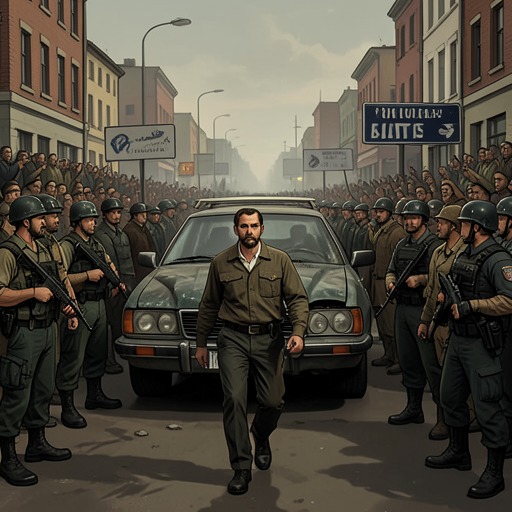
The foreword places Russia at the origin of the novel’s wartime setting. After the 2013 Euromaidan uprising drove Ukraine’s pro-Russian political elite from Kyiv, Russia captured Crimea in 2014 and sent officers, volunteers, and activists into eastern and southern Ukrainian cities to encourage anti-Kyiv revolts. The ensuing war, the foreword argues, is sustained by Russian personnel and supplies; a continuing conflict in eastern Ukraine also obstructs Ukraine’s wider acceptance by Europe and the international community.
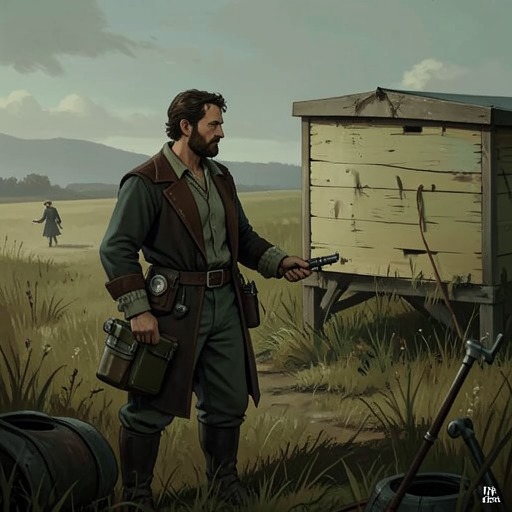
That geopolitical account is translated into the geography around Little Starhorodivka. Ukrainian troops hold positions on one side of the village, while local fighters and Russian military personnel occupy dugouts beyond Pashka’s street and the remnants of an apricot grove. The army has been present for three years. The village’s fields have lost their workers, and its two remaining residents live with the knowledge that armed forces are close, even when the village itself falls quiet. Russia’s military role is therefore registered not only in distant political events but in the arrangement of fields, gardens, and trenches around an almost emptied home.
The novel also shows the political conflict arriving through television. At Nastasya’s, Sergey Sergeyich watches three men discuss Ukraine and the prospect of the country’s collapse. One claims that America and Europe prop Ukraine up with aid; another describes Ukraine as an instrument through which the West hopes to remove Russia from the political map. The broadcast supplies a pro-Russian interpretation of the conflict, but Sergey Sergeyich’s question to Nastasya about whether she understands it frames the program as something encountered in ordinary domestic life, rather than as a settled account of events.
Russia as destination and jurisdiction
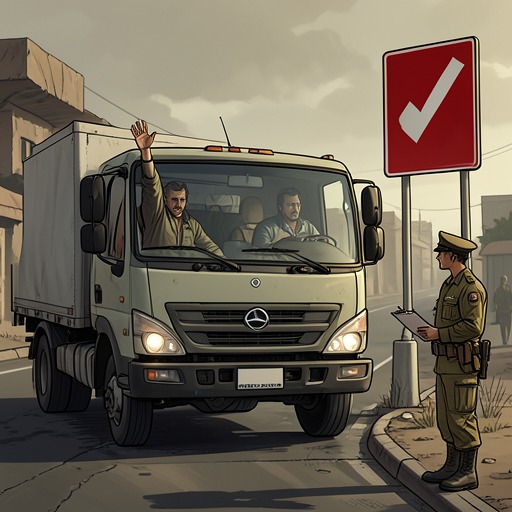
When Sergey Sergeyich leaves the grey zone with his apiary, the journey makes political boundaries practical obstacles. He prepares the hives for transport by closing their entrances, loading them onto a trailer, covering them against the rain, and tying them down. He carries honey as well, reasoning that it retains value like money. At a checkpoint, soldiers question his route through territory they identify as the D.P.R. and O.R.D.L.O.; Sergey Sergeyich explains that Petro advised him to use the route because it was safer. The exchange makes clear that the journey depends on instructions and permissions negotiated amid overlapping authorities, not on an uncomplicated passage across a map.
In the new location, the hives and honey give Sergey Sergeyich a means to establish a livelihood. He barters honey for food at a shop and receives a credit of 560 hryvnias, redeemable in groceries. Later, a claim that the honey is anti-alcoholic helps sales spread to nearby villages. Galya begins paying in cash, and Sergey Sergeyich stores the money in his car’s glove compartment. These exchanges show how a beekeeper displaced by war rebuilds a measure of stability through goods he can produce and trade, even as his security remains dependent on where he is allowed to stay.
The narrative makes the contrast between the usefulness of honey and the limits of formal protection explicit at the Federal Security Service. A guard tells Sergey Sergeyich that he will not receive asylum and that his stay in Russia is limited to ninety days. Sergey Sergeyich replies that asylum is not what he has come to seek: he wants information about Akhtem. The warning turns his visit into a confrontation between his own purpose and the state’s classification of him as a foreign visitor, with a deadline attached to his presence in the country.
Law, family, and the limits of help
The encounter over Akhtem’s family shows how Russian authority reaches into private obligations. A detective explains that Bekir has been driving his dead father’s car for two years without official permission and has also challenged the authorities. Sergey Sergeyich objects that the car belonged to Bekir’s father, whom the detective knows has been killed; the detective answers that the registration and lack of formal authorization make the son’s use unlawful. The disagreement is not simply about who owns or needs the car. It is about whether lived family circumstances count when the state applies its rules.
Sergey Sergeyich asks what he should tell Bekir’s mother. The detective leaves the answer to him, returns his Ukrainian passport and its insert, and warns that if he does not leave Russia within eleven days, he will be brought back not to an office but to a cell. On the drive back to Albat, Sergey Sergeyich and Aisha remain silent; she does not ask what he learned, and he hesitates over whether to tell her. When he later tells Aisylu about the conversation, she struggles to hold back tears. The warning’s consequences thus extend beyond the visitor’s own legal vulnerability: information obtained under Russian authority becomes painful knowledge that must be carried back to a family.
Daily life and narrative significance
Russia’s presence is woven into ordinary needs and small exchanges. During a winter without electricity, church candles and the mention of lard awaken Sergey Sergeyich’s awareness of what his household lacks. What he can readily enumerate instead is honey, vodka, tinctures, and remedies made from bee products. This inventory places the beekeeper’s resources against wartime scarcity, while the broader political conflict remains close enough to shape heat, food, travel, and communication.
The village’s Postal Ceasefire briefly turns the suspension of violence into a public service: mail accumulated during the closure of local post offices is to be delivered during one quiet day. Sergey Sergeyich rises early for the occasion, cooking eggs over coal as March approaches, and later watches for the Ukrainian postal van. Against the war’s competing claims to territory and allegiance, the arrival of Ukrposhta represents a fragile restoration of connection with the outside world. Its brief, practical purpose stands in contrast to the larger political struggle that has disrupted village life.
The novel’s portrayal of Russia therefore moves between scale and routine: the state’s role in the war, the soldiers and checkpoints that govern movement, television’s ideological explanations, and the immigration threat directed at a Ukrainian beekeeper. Yet the story’s central measure is what these forces do to ordinary life. Sergey Sergeyich must keep bees alive, find food, trade honey, navigate uncertain jurisdictions, and try to help a bereaved family while being reminded that his own presence in Russia is temporary and precarious.